By Jeremy Patton
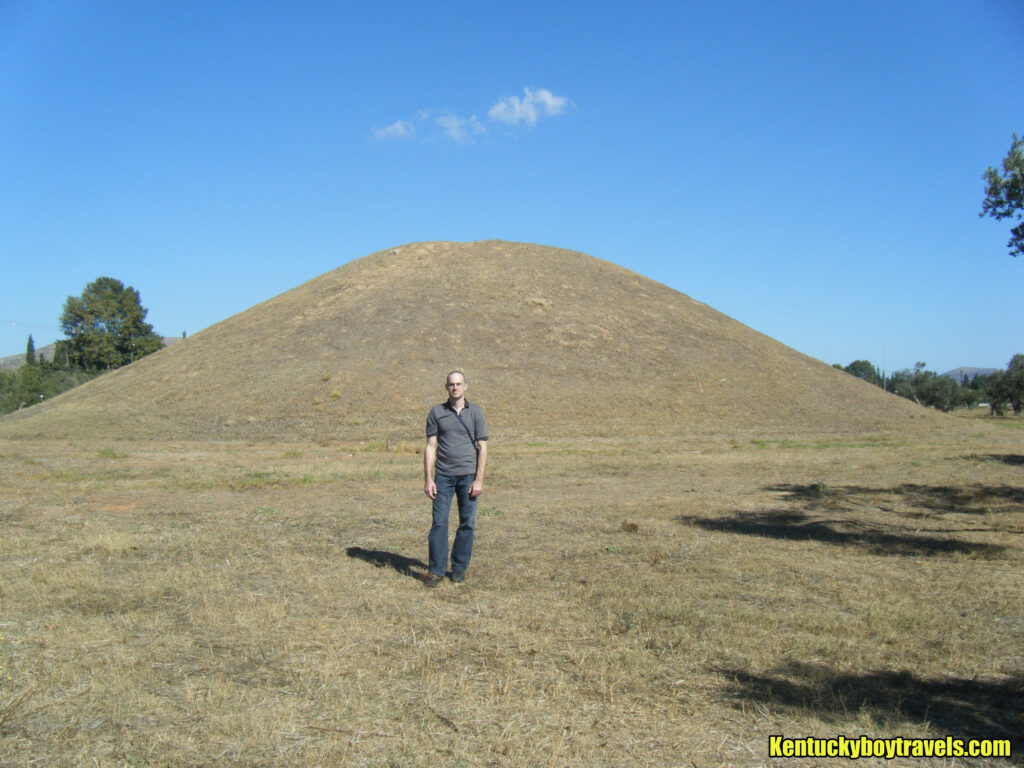
The Burial Mound of the 192 Athenians is a tumulus where the Athenians interred their dead after the Battle of Marathon in 490 B.C.E. The tumulus is located in a small park outside the modern town of Marathon.
History
Great King Darius I of Persia launched an invasion fleet that landed at the Bay of Marathon. His goal was to subjugate Greece and punish Eretria and Athens for supporting revolts that rose up among Greek colonies dotting the western coast of Asia Minor, then part of the Persian Empire.
As tens of thousands of Persians and cavalry (30,000 by some modern estimates) waded ashore, Greek forces awaited anxiously across the plain, sweating beneath the summer sun.
The Greeks had managed to assemble about 10,000 hoplites, comprised of perhaps 9000 Athenians and 1000 Plataeans. Though greatly outnumbered, the Athenian leadership voted to fight on the plain of Marathon rather than submit to Persia and be carried off into slavery. The Persians had conquered Eretria a few days earlier, taking the inhabitants as prisoners.
Herodotus tells us that, before leaving Athens, generals sent a long-distance runner by the name of Pheidippides on a 150-mile trek to Sparta to recruit its assistance in repelling the barbarians. He arrived in Sparta the day after his departure. An annual, ultra-marathon race was established in 1983 that retraces the route supposedly traveled by Pheidippides and has proved many times over that the feat claimed by Herodotus is plausible.
The Spartans, a fanatically religious people even during their own time, were sympathetic to Pheidippides’ plea and agreed to send help, but refused to march to Marathon straight away. They were in the midst of a religious festival called the Carneia that would not end until the next full moon. The Athenians would have to fend for themselves in the meantime.
A standoff ensued for several days until the order was finally “given to move, and the Athenians advanced at a run towards the enemy, not less than a mile away.” (VI, 112) The attack startled the Persians, amazed that the Greeks would rush in with inferior numbers and without the support of cavalry or archers.
The charge allowed the Greeks to avoid an initial barrage of arrows and employ their superior weapons, armor and tactics at close range. The grueling battle ended with a rout by the Greeks, littering the field with dead and sending the enemy fleeing to their ships.
The Persians embarked for Athens, hoping that they could sail to the city faster than the Greeks could march back, thus taking it unopposed.
Some accounts claim that Pheidippedes was again sent as messenger, this time to Athens, relaying that the Greeks had won and the citizens should hold out until they return. After fighting in the battle, Pheidippedes ran approximately 26 miles (the distance could have varied depending on his route), burst into the assembly, shouted “victory” then collapsed and died. Herodotus, our main source for the Battle of Marathon, does not mention this event and many scholars doubt its historicity.
The war-weary hoplites beat the ships back to Athens. “When the Persian fleet appeared, it lay at anchor for a while off Phalerum (at that time the chief harbor of Athens) and then sailed back to Asia.” (VI, 116) The Athenians, with the help of Plataea, had repelled an invasion by the most powerful empire in the world.
2000 Spartans marched to Athens but arrived too late. They continued on to Marathon to inspect the carnage then “praised the Athenians on their work, and returned home.” (VI, 120)
Herodotus reports the death toll as 192 Athenians and 6400 Persians. The numbers are probably exaggerated, but the Persians no doubt suffered heavy losses.
The Athenians buried their 192 dead on the plain of Marathon and covered the grave with a mound of earth known as a tumulus. Numerous excavations were carried out at the tumulus, especially during the 19th and 20th centuries when interest in antiquities soared and hordes of tourists flocked to Greece. Unfortunately, many of these digs were botched projects conducted by amateur collectors and souvenir hunters. At this point in my studies I am uncertain if any artifacts were unearthed and confirmed by professional archaeologists.
Added 2/16/14 – Updated 4/2/14